
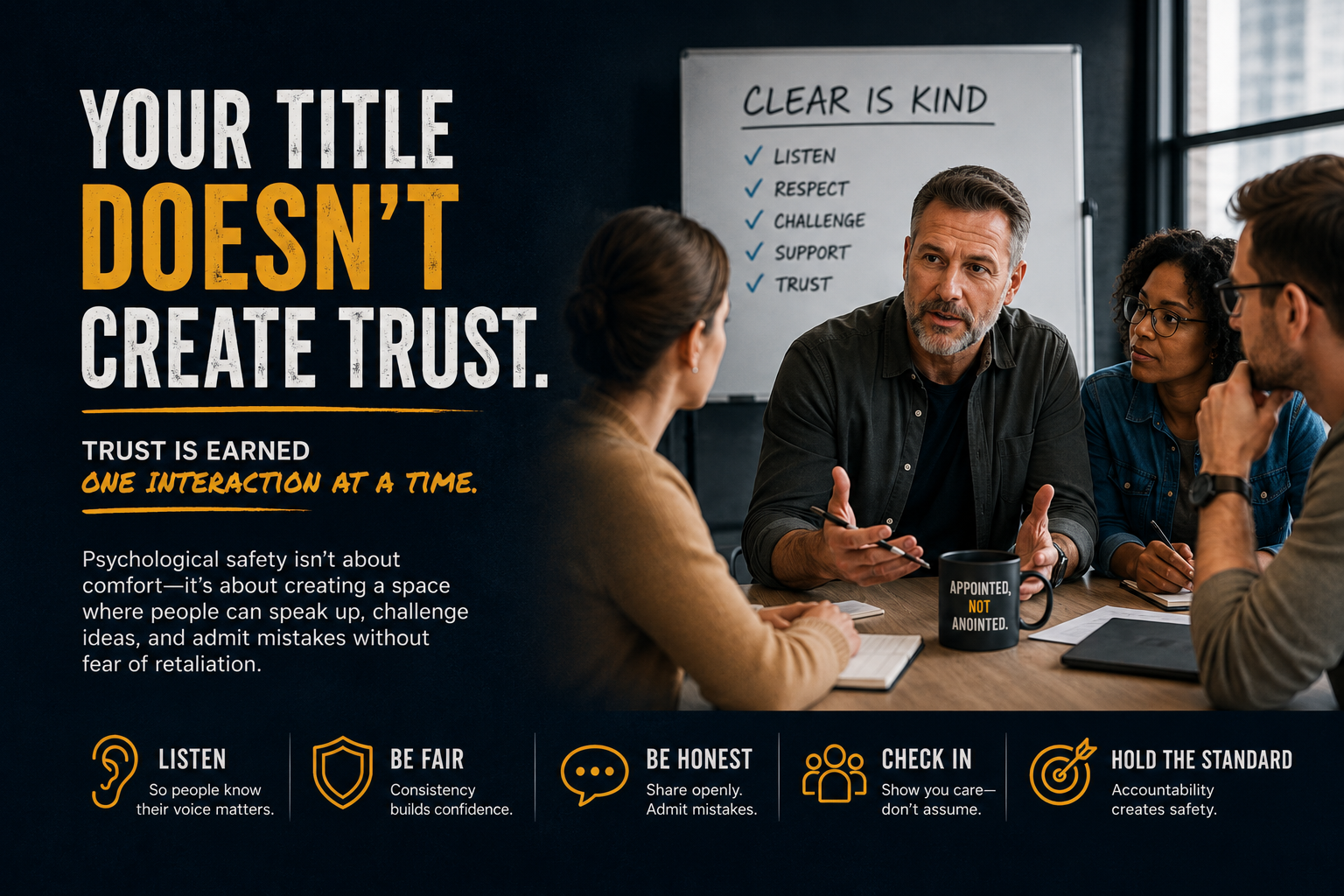
Your Title Doesn’t Create Trust
Continuing from my post about healthy communication in an organization I’m going to drill down deeper on the concept of psychological safety. Frankly, there are people who use this term but clearly don’t know what it is, or, more often than that, don’t know how to build it in an organization.
Having a culture of psychological safety doesn’t mean everybody is nicey-nice. I love Brene Brown’s saying, “Clear is kind.” And I’ve walked teams through Kim Scott’s Radical Candor framework to help have those hard conversations that are critical to growth and a positive work culture. Some of the healthiest teams I have ever been part of disagreed with each other regularly.
I think a great way to think of the concept is that psychological safety is not the absence of tension, but the presence of trust. It is an environment where people can speak honestly, admit mistakes, ask questions, challenge ideas, and raise concerns without fearing retaliation or humiliation.
This becomes especially important when a new leader takes over a team, but intentionality about establishing it should happen in each leadership transition you make, even at the executive level. Whether you are hired from outside the organization or promoted from within, your team is evaluating you long before they trust you. They are asking themselves questions that may never be spoken aloud:
- Is this person fair?
- Can I disagree with them?
- What happens if I make a mistake?
- Will they listen?
- Do they play favorites?
- Can I trust them?
Many leaders make the mistake of believing their title answers those questions. It doesn’t, your behavior does.
Intentionally building a culture of psychological safety does not require certification from a two-day workshop (I’m looking at you ACHE, lol). What it requires is leaders and followers who can let themselves be vulnerable. To check egos at the door. Admitting when you don’t have the answer to a question. Doing all these things in an open setting, mid-stride in meetings, not just in your office in a 1:1.
One of the fastest ways to establish your reputation as a leader is through your reaction to bad news.
- A leader asks for feedback.
- Someone provides honest feedback.
- The leader becomes defensive.
What’s the lesson learned here? Not that their leader values honesty.
A primary lesson is that honesty is only welcome when it aligns with what the leader already believes. People remember how leaders react to bad news far longer than they remember reactions to good news. A word of caution: some leaders ask for feedback when what they really want is agreement. People learn that lesson quickly.
Another challenge is newly minted leaders believing that they must have all the answers.
I have watched countless leaders, especially those early in their leadership journey, feel pressure to be “on point” for every question and every problem. They worry that admitting uncertainty will make them appear weak. I have found the opposite to be true. One of the most trust-building statements a leader can make is: “I don’t know, but let’s figure it out.” Confidence and certainty are not the same thing.
The challenge becomes even more complicated when a leader is promoted from within the team. People are not looking for you to act like their old coworker. They are looking for you to act like a fair and trustworthy leader. The biggest mistake I see newly promoted leaders make is pretending nothing has changed. It has. Yesterday’s peers are today’s direct reports. You don’t have to become distant, but you do have to become consistent. Fairness matters more than familiarity.
Answer this question that every Veteran I know will the same way: would you like to follow someone in harm’s way who acts, says, and (maybe) believes nothing is ever their fault when things go wrong? Hell no. When leaders acknowledge mistakes, ask for help, and demonstrate humility, they give everyone else permission to do the same. It’s critical downrange.
Another misconception is that leaders should give people space and avoid checking in too frequently. In reality, most employees want to know their leader is engaged. They want you to check in on them when they are doing their thing, to show you they know their jobs, and to share the pride they have in their work. So, regular check-ins communicate interest, support, and investment.
Psychological safety is not created through speeches, mission statements, or annual trainings. It is built one interaction at a time. As a leader, your team will not decide whether they trust you based on your first meeting. They will give you grace and decide based on your next hundred interactions. If you lead with transparency, check your ego at the door, and genuinely seek their input you’ll start establishing a culture where people feel safe to give feedback without reprisal, or a blow up in public, or any other unfortunate (and unprofessional) response that doesn’t engender trust. Your behavior will tell them far more than your title ever will. After all, you were appointed, not anointed, to your position.