Distill: From Information to Insight
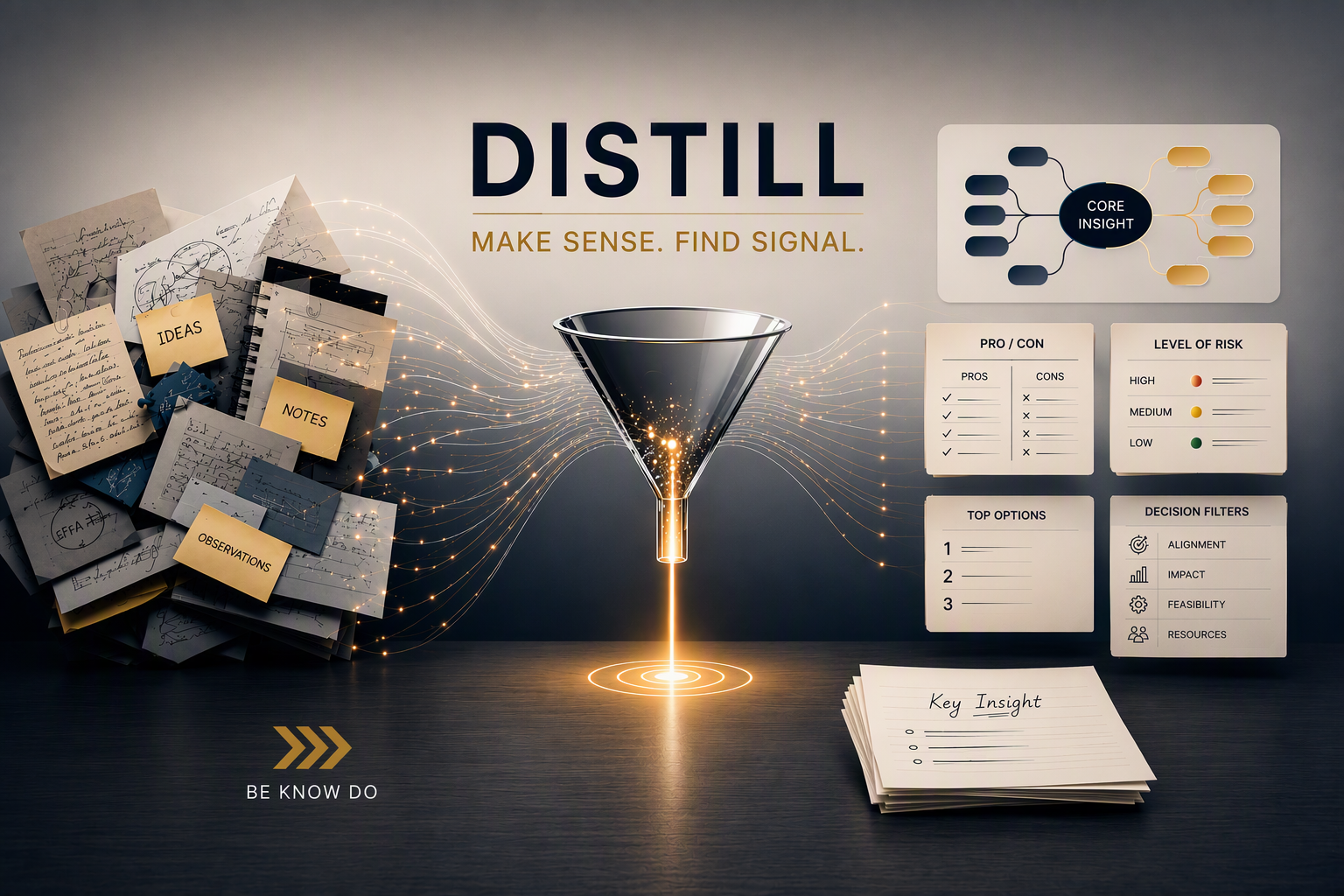
A leader’s real work isn’t collecting information, or regurgitating it later, but making sense of it to the level you can make an informed decision. That is the Distill step of the CODEA² framework. Capture kept an idea from disappearing. Organize made sure you could find it again six months later. But neither one, by itself, helps you decide anything. You are left with a question that can’t be sidestepped: So what? That’s the gap the Distill phase exists to close: turning what you’ve gathered into something you actually understand, and can start making decisions from.
Steps Within Distill
It helps to think of distillation less as a single step and more as a few smaller steps you take every time something new lands in front of you.

Match the Tool to the Question
A common mistake is assuming there’s one correct way to analyze anything — usually whichever method the leader learned first. In practice, the right tool depends entirely on the shape of the question. A staffing shortage and a vendor selection call for different kinds of thinking, even though both will eventually produce a table full of numbers.
The goal isn’t to master every framework below. It’s to have enough of them on hand that you reach for a scalpel instead of a hammer every time.

None of these tools produce a right answer on their own. What they do is force a second look at information you might otherwise skim past.
The Questions That Do the Real Work
Leaders who distill well tend to share a habit: they don’t open with a recommendation. They open with a question, and they let the group sit with it before anyone reaches for a solution.
- What are we actually trying to solve here — not the symptom, the underlying problem?
- What’s the evidence behind this, and how strong is it really?
- What are we assuming that we haven’t said out loud?
- What’s changed since the last time we looked at this?
- What happens if we simply do nothing?
- Which risk in this room deserves the most attention, and which is noise?
- Is there a plainer explanation we’re overlooking because it’s less interesting?
Questions like these slow a conversation down just enough to catch a weak assumption before it turns into an expensive decision. They also change the tone of a meeting — from people defending positions to people genuinely comparing notes.
Set Your Filters Before You Need Them
The worst time to decide what your organization values is in the middle of a heated debate about a specific proposal. Leaders who distill well tend to have already agreed, in calmer moments, on the handful of filters every new idea has to pass through.

Your list may look different, and that’s fine — the categories matter less than the discipline of applying the same ones consistently. Over time, a good filter set stops feeling like a checklist and starts feeling like how the team simply thinks.
Tools and a Discipline, Not Metrics and a Dashboard
People often ask which software or tool makes distillation easier. The honest answer is that the tool matters far less than the habit. Some leaders spread sticky notes across a table. Others talk it through with a trusted colleague on a walk. Plenty use a spreadsheet, a whiteboard app, or a simple notes program. What separates a useful method from a wasted one isn’t the interface — it’s whether it forces you to slow down and think, rather than just giving you a fancier place to pile things up.
You should latch on to the idea that the tools in this article are just starting points, not requirements. Pick two or three, use them enough to build instinct for when each one fits, and let the rest go. Note: I’m partial to mind mapping, not as an initial notetaking process but making sense of my notes, links, and data afterwards. And whiteboarding things so I can glance at it later…you do you.
Where AI Fits
It’s worth naming directly: AI is now one of the fastest tools available for the mechanical half of distillation. Hand it a ridiculously large and varied stack of information and it can cluster themes, draft a first Five Whys chain, or summarize a 40-page report in a way that used to take an afternoon. My creating and launching Be Know Do is 3+ months ahead of what it would be if I didn’t use AI to help make sense of information for me. To be clear: AI is not shortcut around distillation — it’s a way to get to the real thinking faster.
What it can’t do is the other half. It doesn’t know an organization’s mission well enough to say an idea is off purpose. It can’t weigh a risk against your actual appetite for it or tell you that timing is wrong for reasons that have nothing to do with the data. Treat AI as a fast first pass, a coworker to bounce ideas off of, and a tool that can get some inertia going for you.
Where This Leads
Done well, the Distill phase leaves you with more than a well-organized set of notes. It leaves you with a point of view — a clearer read on the situation, a defensible reason for it, and a sense of what should happen next.
That understanding is only worth something once it leaves your head. Which is exactly where CODEA² goes next: Express — turning insight into something clear enough for other people to understand, challenge, make decisions from, and build on.
Bonus image: mind map summary